

Community post
Nature’s Clockwork and Sleep.

One of the few biological urges we can’t control is sleep. Many of us wake up to the sounds of an alarm clock and if we still fill sleepy, it is the worst part of our day. Do you know that the bad sleep affects your entire day.

For centuries philosophers had observed plants opening their leaves during the daytime and closing them at night, and concluded that this curious behavior was driven by sunlight. And when the further research was carried out on Mimosa Pudica, a plant known for its rapid and highly predictable leaf movements, It was found that plants were not responding to an outside force at all, but instead possessed a mysterious kind of internal clock that merrily ticked away regardless of what was happening in the world.

Like a beautifully crafted timepiece, this internal clock worked on a twenty-four-hour cycle and ensured that the plant’s leaves opened during the day and closed at night. From the simplest single-celled organisms to the most amazing mammals the whole of the natural world was controlled by clockwork.
Everyone has a natural tendency to wake up each morning and go to sleep every night. Humans do indeed have an internal clock ticking away inside them.

The brain generates an awake-sleep cycle of approximately 24 hours even in an unchanging environment.
A group of about 10,000 neurons known as ‘Suprachiasmatic Nucleus’ acts as your internal clock and merrily tick-tocks away every moment of your life.
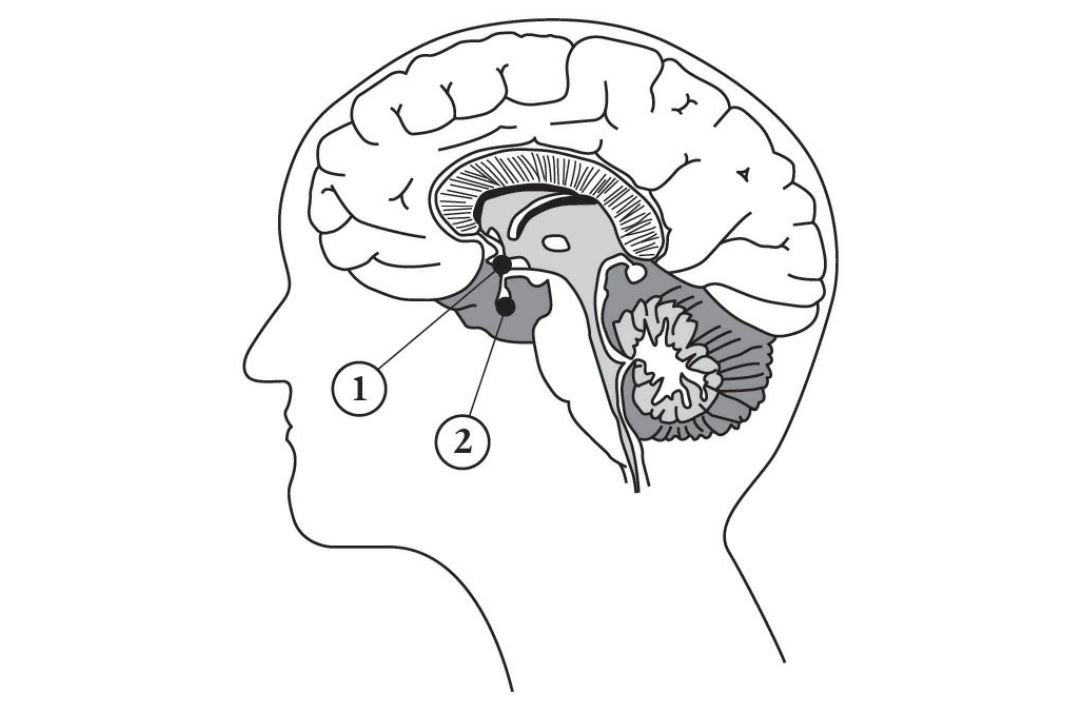
Look at the tiny black dot towards the middle left of the diagram (1). That is your Suprachiasmatic Nucleus, while the other black dot towards the middle right of the diagram (2) is your Pineal Gland.
At certain times of the day, the suprachiasmatic nucleus causes the pineal gland to produce a sleep-inducing hormone called ‘melatonin’, making you feel drowsy and tired. Your internal clock sends these signals as part of a highly predictable pattern that repeats itself every twenty-four hours. Sleep scientists refer to this pattern as a ‘circadian rhythms’, a term derived from the Latin word circa, meaning ‘around’, and dies, meaning ‘a day’.

The internal clock takes more than 24hrs to complete a single cycle. This small difference causes you to slowly drift out of sync with the actual time, and after just a few weeks you would feel sleepy at the start of the day and wide awake when darkness fell.
To help prevent this happening your internal clock is reset each day by several factors, such as when you eat, move around and, most important of all, the amount of light entering your eyes. The light swirling around you right now not only allows you to read these words (and, for that matter, these ones too) but also has a dramatic effect on your brain. This light is entering your eyes and causing your retinas to produce tiny electrical signals that are then stimulating your suprachiasmatic nucleus and pineal gland. When these brain structures receive this stimulation they stop producing the sleep-inducing hormone melatonin, and so you feel alert and awake. However, if you were to turn out all the lights, your retinas would cease to stimulate these bits of your brain, and the subsequent release of melatonin would make you feel drowsy and tired. For this reason, neuroscientists often refer to melatonin as the ‘Dracula hormone’ because it only emerges in the dark.
The quality of 24hrs we spent in a day totally depends on how we manage our sleep. If we master our sleeping habits, we will be very efficient and for rest of the time.
Replies (1)
Congratulations @aaklii! You received a personal award!
You can view your badges on your Steem Board and compare to others on the Steem Ranking
Vote for @Steemitboard as a witness to get one more award and increased upvotes!