

Community post
OverView of Cloud Computing
What is Cloud Computing?
Simply put, cloud computing provides a variety of computing resources , from servers and storage to enterprise applications such as email, security, backup/DR, voice, all delivered over the Internet. The Cloud delivers a hosting environment that is immediate, flexible, scalable, secure, and available – while saving corporations money, time and resources.
Cloud Flavors?
• SaaS – Software as a Service
• IaaS – Infrastructure as a Service
• PaaS – Platform as a Service
• DaaS – Desktop as a Service
What is Software as a Service? (SaaS)
• SaaS is a software delivery methodology that provides licensed multi-tenant access to software and its functions remotely as a Web-based service.
• Usually billed based on usage
• Usually multi tenant environment
• Highly scalable architecture
Infrastructure as a Service (IaaS)
• IaaS is the delivery of technology infrastructure as an on demand scalable service
• Usually billed based on usage
• Usually multi tenant virtualized environment
• Can be coupled with Managed Services for OS and application support
IaaS is not Managed Hosting
• Traditional managed hosting is a form of web hosting where a user chooses to lease entire server(s) housed in an off-site data center.
• Term based contracts based on projected resource requirements
Platform as a Service (PaaS)
• PaaS provides all of the facilities required to support the complete life cycle of building and delivering web applications and services entirely from the Internet.
• Typically applications must be developed with a particular platform in mind
• Multi tenant environments
• Highly scalable multi tier architecture
Different Deployment Models
Public cloud
• Public cloud (off-site and remote) describes cloud computing where resources are dynamically provisioned on an on-demand, self-service basis over the Internet, via web applications/web services, open API, from a third-party provider who bills on a utility computing basis.
Private cloud
• A private cloud environment is often the first step for a corporation prior to adopting a public cloud initiative. Corporations have discovered the benefits of consolidating shared services on virtualized hardware deployed from a primary datacenter to serve local and remote users.
Hybrid cloud
• A hybrid cloud environment consists of some portion of computing resources on-site (on premise) and off-site (public cloud). By integrating public cloud services, users can leverage cloud solutions for specific functions that are too costly to maintain on-premise such as virtual server disaster recovery, backups and test/development environments.
Community cloud
• A community cloud is formed when several organizations with similar requirements share common infrastructure. Costs are spread over fewer users than a public cloud but more than a single tenant.
Enterprise Cloud Solutions
- Hybrid Cloud
• Scalability of the Public Cloud with the control and security of a private cloud - Test / Development / QA Platform
• Use cloud infrastructure servers as your test and development platform - Disaster Recovery
• Keep images of your servers on cloud infrastructure ready to go in case of a disaster - Cloud File Storage
• Backup or Archive your company data to cloud file storage - Load Balancing
• Use cloud infrastructure for overflow management during peak usage times - Overhead Control
• Lower overhead costs and make your bids more competitive - Distributed Network Control and Cost Reporting
• Create an individual private networks for each of your subsidiaries or contracts - Messaging Alternatives
• Replace Microsoft Exchange and SharePoint with Google Apps - Rapid Deployment
• Turn up servers immediately to fulfill project timelines - Functional IT Labor Shift
• Refocus your IT labor expense on revenue producing activities
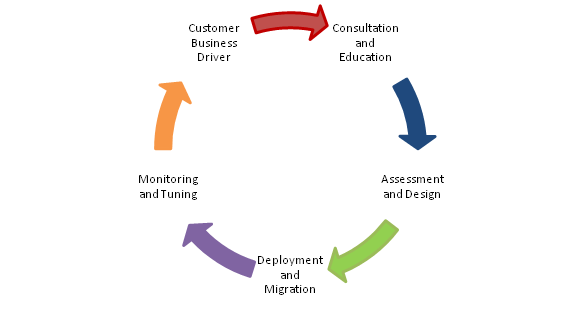
Service Deployment Methodology
• It is paramount that IT and business goals are aligned throughout the process when considering a move to cloud computing, such as cost savings, security, control, flexibility, manageability, simplification, ease of use, expandability, reliability, availability…
Conclusion
• Cloud Computing is outpacing the IT industry
• Real business value can be realized by customers of all sizes
• Cloud solutions are simple to acquire, don’t require long term contracts and are easier to scale up and down as needed
• Proper planning and migration services are needed to ensure a successful implementation
• Public and Private Clouds can be deployed together to leverage the best of both
• Third party monitoring services ensure customer are getting the most out of their cloud environment
• Security Compliance and Monitoring is achievable with careful planning and analysis
**** More Post to come on Technical Cloud related topics , specially working on Azure & AWS .. ****
Replies (6)
✅ @cryptonapro, I gave you an upvote on your post! Please give me a follow and I will give you a follow in return and possible future votes!
Thank you in advance!
yup ! done
Welcome to steemit.
Thank you :-)
@cryptonapro you were flagged by a worthless gang of trolls, so, I gave you an upvote to counteract it! Enjoy!!
Congratulations @cryptonapro! You have completed the following achievement on Steemit and have been rewarded with new badge(s) :
Click on the badge to view your Board of Honor.
If you no longer want to receive notifications, reply to this comment with the word
STOPDo not miss the last post from @steemitboard:
SteemitBoard World Cup Contest - The results, the winners and the prizes