

Community post
Why we should eat insects
Why we all should eat insects – Part 1: The nutritional value
Imagine sinking your teeth in your favourite snack, while you hear the anticipated crunchy sound, the deep, nutty flavour tastes like heaven in your mouth. This is not only delicious, you think, but also completely guilt free. You are consuming absolutely no sugar. Only proteins and healthy fatty acids which will boost your physical and mental performance and the environmental and animal friendly production makes the enjoyment of eating these dry roasted crickets complete. You only ask yourself why you haven’t started eating insects earlier.
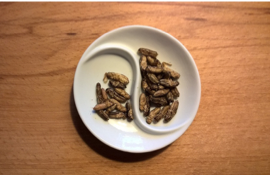
Consuming bugs, mealworms, crickets and other insects may sound strange or even appalling to most of you, but a lot of people would disagree. More than 2 Billion people practice entomophagy, the fancy word for eating insects. It is only really the western world which has given up eating insects. All early humans ate insects. This started to change once we slowly gave up the hunter-gatherer lifestyle and became more proficient at agriculture, food storage and animal domestication. As a result of our sedentary life, we had to build secure houses to keep the cold and wild animals out. We started seeing insects in the house as a sign of an open seal, a threat to the security of the house, where not only insects but also the cold and can creep in and therefore attached a negative stigma around it. Eating insects was and is more popular in warmer climates. Simply because the tropical climate facilitates the growth of insects. Bigger insects equal a greater source of food and it’s only natural to take advantage of that.
In this 4 part-series we are going to explore why eating insects will be normal for all of us in the future and why you should start sooner than later. In the first part, we look at the immediate benefits for you: The incredible nutritional value.
There are more than 1’900 edible insects in the world. Most eaten are beetles (31%), caterpillars (18%) and crickets (13%). In Brazil ants are often eaten fried or dipped in chocolate. Thailand considers many different insects a delicacy, even the businessmen in Bangkok are willing to pay an extra for a bag of dried crickets. In many more countries is eating insects considered normal. Many compelling reasons to start thinking about edible insects exist for all of us. The most important ones are environmental and societal benefits and the unexpected nutritional value, which we will look at in this first part.
Nutritional data of insects is highly variable and depends heavily on the metamorphic stage (the growth stage), the insects’ habitat, feeding methods and processing method. Therefore, we will not look at a specific data set but have a more universal overview.
Protein
Edible insects generally have a very high protein content. Usually over 50% and up to 80% of their dry matter weight, which is important because most insects are eaten dried or even grinded up and used as flour. The protein content is comparable to beef and chicken, but the insect’s much lower fat content stands out in comparison.
Amino Acids
Amino Acids are the building blocks of protein. There are around 500 known amino acids. But only 20 appear in the human genetic code. Every single one of them is required to build the protein in your body. Ingested protein is broken down into different amino acids and then selectively put together for various purposes. These newly built proteins make up a good amount of solid matter of the body.
There even are two amino acids which help building neurotransmitters. tryptophan which produces serotonin, a mood regulator and tyrosine, which synthesises adrenaline. Both of these amino acids compete which each other to accesses the brain. If you ingest a lot of carbohydrates, tryptophan gets more support and therefore you become sleepier. On the other hand, a protein-rich meal is beneficial for tyrosine, which consequently will give you more energy.
Edible insects contain a broad variety of amino acids and a high protein-to-carbohydrate ratio, therefore will help you to stay alert and awake. Very much the opposite of snacking a donut.
Specially a western diet which is high in cereal proteins can profit from consuming edible insects. Cereal Proteins are low in lysine, an essential amino acid. An addition of insects which have a high lysine content would make it a more balanced diet. To generalise, edible insects contain more amino acids than the usual animal protein consumed in western diets.
Not just a “omnivore” diet could benefit from supplementing some form of insect protein but even more so vegetarian and vegan diets lack certain essential amino acids. This is important to consider as your body is not able to produce all essential amino acids for an optimal, healthy performance but relies on nutrition to supply them.
As a side note for those concerned about animal welfare, it is generally assumed that insects do not feel pain. They do not show a pain response nor do possess pain receptors. Some researchers argue that more research is needed. This topic could be a whole other article.
If you are really interested in the breakdown of minerals and amino acids have a look at this report.
onlinelibrary.wiley.com/doi/10.1002/zoo.21246/pdf
A research article breaking down nutritional value of different insects. Although, it looks at the value of insects as animal feed, it might be interesting for the geekier ones amongst you.
Fat and oil
Edible insects are an excellent source of healthy fats. Their oils are rich in polyunsaturated fatty acids and frequently contain the essential linoleic and α-linolenic acids. These essential fatty acids are recognised to have a positive impact in the health development of infants and children.
More importantly, insects are also a source of omega-3 and omega-6 fatty acids and could be a cheaper and more accessible source for landlocked countries with lower access to fish food sources.
Minerals and Vitamins
Many edible insects have a high mineral content. Iron, zinc and magnesium are prevalent in all insects. This is specially interesting for athletes with high magnesium requirements and people, often women, who are iron deficient.
Insects also contain healthy fibre which is beneficial for your digestion. Chitin is a certain kind of fibre found mainly in insects which will not only support your gut-functions but some research even suggests that it has antiviral properties and helps some individuals to be more resistant against pathogenic bacteria and viruses and to reduce allergic reactions.
Vitamins essential for enhancing the immune system and stimulation of metabolic processes are present in most edible insects. The actual amount and range of vitamins differ more between insects than other nutritional components, but as a rule of thumb edible insects contain A, E, B1, B2 and B12 Vitamins. B vitamins mainly supports the cellular energy production. Although B12 deserves an honourable mention as it also vital for the DNA synthesis and for a functional nervous system, especially vegetarian and vegan diets lack Vitamin B12.
But how do insects actually taste?
Yes, all these facts and figures sound great.
Yes, Insects are proven to be very healthy for you.
But the best news: They even taste great!
Edible insects are very taste-malleable, they tend to adopt the taste of what they have been fed (think mint-fed crickets which of course, taste very minty) and in what they have been cooked. For example, chili powder crickets, lemon crickets or crickets in a salad will all taste very different.
But generally, insects have a rather nutty flavour. Especially dry roasted crickets taste and feel very similar to roasted pine nuts. Munching tarantula-legs is just like eating chicken wings. Escamoles, so called Mexican insect-caviar, tastes just like blue cheese. If nobody told you, you would probably never find out you just ate a larva- instead of a cheese-burrito
If you feel like you want the benefits of consuming insects but you still feel a little intimidated by the legs, wings and heads. Try cricket flour (which is a great, protein-packed option if you want to stay gluten-free) or an insect protein shake. Before you know you will munch a nice crunchy bag of dried crickets or a juicy larvae burger.
As we can see, insects are just as healthy as your beef. But they possess a few striking advantages over commonly consumed livestock.
- Different processing methods, there are many ways to incorporate insects into your diet. To mention a few: Flour, Protein Bars, Protein Powder, dried, cooked, covered in chocolate and so forth.
- The high ratio of protein to dry weight and the high diversity of amino acids
- Omega-3 and -6 levels are comparable to ocean-fish
- Unlike fish or meat insects rarely contain heavy metal traces, hormones or antibiotics.
- They simply taste great!
There are also environmental, ethical and societal factors to consider. In the next part, we will discover why edible insects are a viable choice and less destructive to the environment than our current favourite animal protein.
Sources
No copyrights were hurt while writing this article, all pictures are license-free.
(If you would like to have a more proper quoting system next time, just let me know)
http://www.fao.org/news/story/en/item/175922/icode/
http://www.fao.org/docrep/018/i3253e/i3253e.pdf
https://www.sciencedirect.com/science/article/pii/S2352364616300013
https://www.sciencedaily.com/releases/2014/06/140625101215.htm
http://journals.plos.org/plosone/article?id=10.1371/journal.pone.0118785
http://www.fitbit.com/foods/Chicken+Breast+Boneless+Raw+Meat+Only/21639
https://www.sciencedirect.com/science/article/pii/S2352364616300013#bb0080
https://askentomologists.com/2015/02/09/why-dont-we-eat-bugs-in-western-culture/
https://www.livestrong.com/article/426255-what-is-the-function-of-amino-acids-in-the-human-body/
https://www.ncbi.nlm.nih.gov/pmc/articles/PMC3649463/
Replies (5)
I think insects would be a better alternative than the massive amount of meat-consumption in today's world. They are a better match nutritionally speaking, but still - why eat other life forms when we transition to a vegan species? I think that "fake meat" will be the more appealing substitute for meat in the future, not insects. Just the fact that insects are not at all appealing for any of our senses will make it very hard for people to start eating them on a global scale. Have you ever seen insects crawl around your house and thought that it would be a great snack? I don't think so, and this is simply because it's not a foodsource our digestive system would want you to ingest. Fruit, however our senses are super-appealed towards fruit, have you given the fruitarian diet any thought? Nice reading your article, have a great day!
The artificial meat probably will make "real meat" consumption obsolete eventually, but at the moment it is still way to expensive to be used in mass scale. Are we transitioning to a vegan species?
Actually insects have been a part of the human diet for ages ,it is even mentioned in the bible. Many cultures on earth already consider insects a snack. however, I have not learned about the fruitarian diet, but the first question I have about it is, where do we get the protein / amino acids from if we only eat fruit?
Thanks for reading and have a great day too!
I tried insects ONE TIME in South Korea.
Never, EVER again am I doing that.
It was some kind of silk worm and it had a very bitter taste. I know things that don't taste all that good are usually good for you but I darn near threw up from it!
https://media.giphy.com/media/pVAMI8QYM42n6/giphy.gif
haha, boiled silkworms are surely an aquired taste. Not exactly my favourites. How did you like south korea tough? Your Vlog looks interesting!
Upvoted. sorry, I don't know etiquette, just made my account yesterday, just wanted to let you know I cited you in my post about entomophagy recipes: https://steemit.com/introduceyourself/@mickeyd/my-name-is-mic-and-i-ll-teach-you-how-to-eat-bugs