For us to have a right there are two things that are necessary. First that we know what the right is, and second that there is an entity that will enforce the right. The problem with natural rights is that it is hard to know what they are apart from individual's opinions, and there isn't anyone who can enforce them.
If I may politely disagree, I don’t believe there is any necessity (as opposed to practicality) of having someone other than oneself to enforce rights.
There are obviously some benefits to having some sort of small, streamlined authority to enforce those rights (see e.g. Ayn Rand and her disagreement with pure anarcho-capitalism), but it’s nit a necessecitu either for the right to exist or for the right to be exercised.
As I understand it, a right is a right by virtue of its existence and not grounded on any other conditions, meaning that if we believe something is a right, it exists, whether or not we know it exists and whether or not we have any way to currently enforce it.
We could have a totalitarian dictatorship that, after a thousand years of control and propaganda, erases all memory of any rights of individual liberty and quashes any hint of any attempts by anyone to enforce anything even remotely passing for the right to individual liberty.
But would that really mean that because no one knows what the right to individual liberty is and no one has any means to enforce it but by their own actions were they to ever come upon the concept inspire of the totalitarian dictatorship?
I think we can still say that even in that situation the right to individual liberty still exists, because it’s something more than a legal delineation. Rights seem to have their basis in a kind of internal goal possessed by human beings as human beings. They’re necesssrily aspirations tied up with the human condition.
Sure, Bentham would say I’m just babbling nonsense on stilts, but it’s not as if he (or anyone else for that matter) has some better justificstion for their political philosophy of choice, meaning that if there is going to be an unjustified leap over the is-ought gap, why not do it in the name of the basic enduring right of human liberty?
As I understand it, a right is a right by virtue of its existence and not grounded on any other conditions, meaning that if we believe something is a right, it exists, whether or not we know it exists and whether or not we have any way to currently enforce it.
A right that is not enforced is not a right at all. It's notable that the 'natural rights' that Napolitano lists in this video are those codified within the constitution and enforced by the United States government. He is talking about legal rights and confusing them for natural rights.
Natural rights are no better than people's opinions. You can say that someone 'ought to have a right', and maybe you can work and get that enshrined in law, but until it becomes a legal right it really is just an opinion. The rights that matter, the ones that people want, are legal rights.
I’m not against the whole legal positivism thing (I’m a pretty big Joseph Raz fan), but it’s not as if that’s the last word on things.
Because it starts to break down as a means of structuring shared community activities guided by norms (i.e. “laws) if you start with the premise that there’s no underlying guidelines to circumscribe the sheer brute power of legal authority in any legal regime.
For example, if we start sticking with “there are no rights except those enshrined in law,” then Judges in common-law countries have absolutely no ability to do there jobs, other than assuming (like Raz does) that whenever there isn’t a statute or directly applicable precedent, the judges are just empowered to and are legislating without restriction.
But, in reality that’s not what happens. We can look at how judging happens in common-Law countries and they are never claiming to be legislating, they are never said to have been given power to legislate, and people don’t commonly understand judges as engaging in unconstrained legislation.
Because Judges, in cases with no statue and no applicable precedent, are trying to find the right Fit and Justification for their legal rulings that ultimately create new laws. They utilize underlying, uncodified principles and processes which are just generally accepted “to be” (when people think about them at all) by judges and the general population.
If judges didn’t try to fit or justify their decisions when gap-filling the laws, nearly everyone would consider this not just “wrong” but “illegal” even though there is no enshrined law, in statute or binding case law precedent, making this “illegal.”
That underlying sense of “illegal” by the overwhelming majority of any given community where something occurs that isn’t against any actually enshrined law...that, so the argument goes, is the substructure of “rights” that seem to exist as a general intangible part of the human condition.
if you start with the premise that there’s no underlying guidelines to circumscribe the sheer brute power of legal authority in any legal regime.
That is certainly not what I think. Rights do not spring from nowhere: They derive from certain moral values that are commonly shared within a society - such as that murder is wrong. There is no absolute morality however, as witnessed by the fact that slavery was once considered moral, but is no longer.
It is only once moral values are enshrined in law that they become rights and cease to be only opinions.
Oh yeah, of course! I don't even think that idea is wrong. When communities share certain moral values then they take those values and plug the label "right" onto them, and then enshrine them into the fabric of their legal society in such a way that those rights have become legally enforceable rights.
I'm absolutely with you all on that.
But I'm losing you on "It is only once moral values are enshrined in law that they become rights and cease to be only opinions.?
Because there's a lot packed into the concept of that "enshrined in law." What exactly does it mean to "enshrine something in law." Or, in other words, at what moment does this kind of metaphysical transformation occur when something that is a value commonly shared within a society shift from being a communal moral...i.e. an "opinion" as you put it, become a law, and then from there, a right?
"Enshrining into law" can mean any number of things. It could be when some relevant institution says the required words and the required times and puts those words in the required book that those words become "Law." Of course, you have to ask, where do we look to find the rules defining and delineating the "relevant institution" the "required words" the "required times" and the required books"
To make it seem less muddle, we can go with your specific about "murder is wrong."
We live in, say, Maryland. Marylanders have a communal value shared within their Maryland society that murder is wrong. So they call their legislature in session, the legislature goes through their whole process to pass a bill into a law, it becomes a law, its thrown on the governer's desk, he signs it, and the police are empowered to enforce the law against murder.
So where do we look to make sure that is a law? We have to be sure it is, in fact a law, and not just something some legislature said to his body on the side of the room.
One of the places we look is the the rules and procedures of the various houses and the Governor's authority, to determine that that did, said, and accomplished what they need to accomplish in the prescribed matter in order to take this opinion about murder and transform it into a law.
You could then ask, where do the rules and procedures of the maryland legislatures and the governor obtain their authority to delinate rules for law making procedures.
So go back one further and you're likely to find yourself at the Maryland Constitution (perhaps a judiciary act, which itself would trace back to the MD Constitution) and some common-law precedents that carried over from colonial times and then England before that.
Ignoring the Common Law Precedents going back to colonial times and even England, because of their weirdness, you find yourself looking at the Constitution in order to see how we know that the legislature and governer has the authority to pass the "murder is illegal" law, and the ensure that all the proper procedures were followed according to the proper authorities.
So you hold up your Constitution and you say, "This is it! This is the source of the authority for the legislatures rules committee to make rules that govern the procedures for the legislature to pass laws that will be valid laws."
And then I come in (because I'm a jerk that likes to grind down to the root of things until you want to punch me in my fat mouth) holding up the Bible. And I say, well I have a copy of the bible here and it says some different things about passing laws and murder. Why is the Constitution more relevant an authority to "enshrine something" into law so that we can actually, finally, have our right!"
Your answer would obviously be that the Constitution was agreed upon by the People and therefore it is the agreed upon norms of the community.
I'd soon be asking you a number of questions related to that response, including wondering why my grandchildren are bound on something a group of people agreed upon 300 years ago. You may respond because that's how law works, but that's a trick, because our whole conversation is trying to figure out exactly that. You could say because Constitutions can't exist without the assumption that they will be binding for future generations, and I will then ask what would be so bad if we don't have a Constitution, and you may soon tell me that without Constitutions we don't have rights.
I could then give you a big, obnoxious, pedantic rant about how, in that case, let me explain to you why we don't actually, even have a constitution today, by the constitution's own standards, to which you would say that I'm crazy (yeah I probably am) and that I'm wrong because notwithstanding all that, everyone just agrees that the Constitution is the Constitution and that its enforceable.
I would then ask you what you would call it when everyone just agrees that the Constitution is the Constitution and that it is enforceable, even though, through its own words and legal procedures the Constitution rendered itself voidable (if not void) from almost the start, and by its own terms is not a valid Constitution.
It's that underlying communal agreement about the nature of certain human relationships manifesting in the legal realm, but which aren't contrained the the normal legal procedures that are absolutely necessary to all other "laws" themselves....that's what I'm calling, for lack of a better word, the concept of "rights."
They're obviously, in that situation, unclear, and hard to delineate. But they seem to somehow exist as something more than opinion, insofar as everyone will do mental and emotional loopty-loops, and contort into philosophical pretzels just to avoid the fact that most of the things they take for granted were never actually, properly, put into place using any kind of accepted "legal enshrining."
A lot of the stuff was just stuck in there, called a law, called a right BECAUSE it's a law, without realizing that the law has been invalid (by its own terms if legal procedure means so much to the process)
But the stuff that was still considered absolute and necessary, and intrinsic to all humans, even when the laws seemed to have failed to properly codify them or enshrine them....those are the things that I would submit are what we are talking about when we talk about rights.
You could say that they are just "super opinions that everyone agrees on," which could be true, but to require their being put into law in order to make them "enforceable" or to raise them up to the level of "rights" means a requirement of taking those super opinions that everyone agrees on out of the realm of moral or ethical shared community activity, and shifting it over into Law as a Shared Community Activity, with the difference being that once you "legalize" something, it now has to go through all the ins and outs and twists and turns of any other law, which is just as subject to being questioned, and just as subject to lacking in non-arbtirary enforcement authority as any other norm-thick activity to which we don't ascribe "legal significance"
tl;dr version: Law is just a formalization of Shared Communal Activities that has its own internal logic that need not (or some would say cannot) look outside to ethics or morals to make decisions about the "legal" or the illegal." So why should Law have any special powers to turn "shared opinions of the community" into a "right" just by placing them into the legal system?
Rights may just be the shared opinions of the community that are pre-existent to law. Once you bring law into it, you're taking the term "right" but you're turning what you originally had into a whole knew thing, because a legal system requires following that systems processes and procedures, which often have something to do with the substance of the "right" we are trying to codify into a "legal right."
So why not just leave those alone? Or at least separate them out into to distinct categories even though they share some of the same terminology.
Legal Rights are one thing. Rights, Generally, are another thing.
Rights can absolutely be a real thing and exist without ever touching the law or a legal system.
If you want to argue that rights can exist apart from the law, you need to explain in what sense they exist.
In my view, a right requires two things: It needs to be codified - that is described definitively so that it is clear what it is and to whom it applies, and it needs to be enforced. In this definition a right is inseparable from a law.
You appear to think that a right is something beyond this however. That you can have something that is a right but is not a law. From my point of view, I don't see how such a thing meets the two requirements of a right that I described above.
To take an example: You might say that people have a right not to be enslaved. But what about in America in the 18th century? Was this right encoded anywhere? Was there anyone to enforce it? The answers to both are no.
I might in fact find myself saying that 'The people who were slaves had a right not to be slaves', but what I would really mean is that they ought to have had the right. I believe that slavery is morally wrong, but that's really just my opinion. Many people in the past, not necessarily monsters, thought that slavery was perfectly acceptable.
Yes, we can use the term 'right' to describe the moral judgement that I have just described, but we are needlessly introducing an ambiguity. We can talk about 'moral rights' and 'legal rights', but again it is important to mark the distinction so as to avoid confusing others (or indeed ourselves!)
I thought I’d already done that but if it wasn’t clear enough then that’s my failing, not yours, i’ll try again:
Rights exist as the underlying sunstratum of reasons, principles, and rationales which are never “enshrined into law” by codification or binding precedential case-law, but which are still both necessary for making decisions within any system where shared communal activities are structured by norm-thick concepts like “Law.”
In other words, when Judges are faces with a situation in which no direct law applies, and those judges must still render a decision about “what is the law” (all of which is the majority of what any judge is actually, in reality, doing) the Judge can’t simply say “the
Law is x, because I hate the cold weather.” It’s not codified or enshrined anywhere that the judge can’t do this. But it’s understood, generally, that when a judge does this it is not proper in a sense over and above “my individual morals are opposed to this.” People know that this isn’t illegal by any enshrined laws, but they also know this isn’t just a subjective moral issue.
That feeling of being something more than morally wrong but not actually illegal...that’s where rights are.
It’s like the old case of the orphan inheriting his parents estate under ther will as their sole beneficiary after he murdered his parents, in a jurisdiction where there was no law against inheriting money from your parents even if you admittedly just brutally murdered them to get the inheritance.
The Judge recognized that even though this wasn’t illegal to have the murdered inherent, it was something more than just immoral under his personal moral system. It was just, essentially, a violation of a number of non-legal rights (oftentimes expressed in various principles and maxims scattered about as dicta in case-law or treatises) which weren’t ever explicitly made law, but which were protectable rights in any event.
Those are rights. You could call them a communties’ “Super-morals” that don’t need to depend on law at any given moment for their own existence, Recognition, or enforcement.
Rights exist as the underlying sunstratum of reasons, principles, and rationales which are never “enshrined into law” by codification or binding precedential case-law, but which are still both necessary for making decisions within any system where shared communal activities are structured by norm-thick concepts like “Law.”
'Reasons, principles, and rationales', seem to me to be the things at the very foundation of reason. I don't see the need to put 'rights' or anything much else below these.
As I've said, if you want to talk about 'moral rights' apart from 'legal rights', that's fine, as long as the distinction is made. The problem is when the two are confused and people talk about moral rights as if they were legally enforceable, which they are clearly not. Napolitano makes this mistake.
The example you give is no more than that of a public official acting within his remit and not an example of 'natural rights' somehow transcending the law. If the judge was to overextend himself and start being creative with the law beyond his license he would certainly be sanctioned by his superiors.

 4th Street Bar
Hive-Bar
4th Street Bar
Hive-Bar
Replies (21)
The Judge!
The only sane person on Fox.
Interesting..
Love Judge Napolitano!
Nice! He is great at making things so simple!
Right on!
Agreed.
He does!
Judge NAP...
For us to have a right there are two things that are necessary. First that we know what the right is, and second that there is an entity that will enforce the right. The problem with natural rights is that it is hard to know what they are apart from individual's opinions, and there isn't anyone who can enforce them.
President Ron Paul and VP Napolitano was my ideal for a presidential dream team. Long live Freedom, Justice and Liberty !
If I may politely disagree, I don’t believe there is any necessity (as opposed to practicality) of having someone other than oneself to enforce rights.
There are obviously some benefits to having some sort of small, streamlined authority to enforce those rights (see e.g. Ayn Rand and her disagreement with pure anarcho-capitalism), but it’s nit a necessecitu either for the right to exist or for the right to be exercised.
As I understand it, a right is a right by virtue of its existence and not grounded on any other conditions, meaning that if we believe something is a right, it exists, whether or not we know it exists and whether or not we have any way to currently enforce it.
We could have a totalitarian dictatorship that, after a thousand years of control and propaganda, erases all memory of any rights of individual liberty and quashes any hint of any attempts by anyone to enforce anything even remotely passing for the right to individual liberty.
But would that really mean that because no one knows what the right to individual liberty is and no one has any means to enforce it but by their own actions were they to ever come upon the concept inspire of the totalitarian dictatorship?
I think we can still say that even in that situation the right to individual liberty still exists, because it’s something more than a legal delineation. Rights seem to have their basis in a kind of internal goal possessed by human beings as human beings. They’re necesssrily aspirations tied up with the human condition.
Sure, Bentham would say I’m just babbling nonsense on stilts, but it’s not as if he (or anyone else for that matter) has some better justificstion for their political philosophy of choice, meaning that if there is going to be an unjustified leap over the is-ought gap, why not do it in the name of the basic enduring right of human liberty?
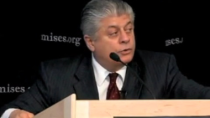
A right that is not enforced is not a right at all. It's notable that the 'natural rights' that Napolitano lists in this video are those codified within the constitution and enforced by the United States government. He is talking about legal rights and confusing them for natural rights.
Natural rights are no better than people's opinions. You can say that someone 'ought to have a right', and maybe you can work and get that enshrined in law, but until it becomes a legal right it really is just an opinion. The rights that matter, the ones that people want, are legal rights.
this should be common sense, but because we are SO brainwashed, we can even understand it most of the time
I’m not against the whole legal positivism thing (I’m a pretty big Joseph Raz fan), but it’s not as if that’s the last word on things.
Because it starts to break down as a means of structuring shared community activities guided by norms (i.e. “laws) if you start with the premise that there’s no underlying guidelines to circumscribe the sheer brute power of legal authority in any legal regime.
For example, if we start sticking with “there are no rights except those enshrined in law,” then Judges in common-law countries have absolutely no ability to do there jobs, other than assuming (like Raz does) that whenever there isn’t a statute or directly applicable precedent, the judges are just empowered to and are legislating without restriction.
But, in reality that’s not what happens. We can look at how judging happens in common-Law countries and they are never claiming to be legislating, they are never said to have been given power to legislate, and people don’t commonly understand judges as engaging in unconstrained legislation.
Because Judges, in cases with no statue and no applicable precedent, are trying to find the right Fit and Justification for their legal rulings that ultimately create new laws. They utilize underlying, uncodified principles and processes which are just generally accepted “to be” (when people think about them at all) by judges and the general population.
If judges didn’t try to fit or justify their decisions when gap-filling the laws, nearly everyone would consider this not just “wrong” but “illegal” even though there is no enshrined law, in statute or binding case law precedent, making this “illegal.”
That underlying sense of “illegal” by the overwhelming majority of any given community where something occurs that isn’t against any actually enshrined law...that, so the argument goes, is the substructure of “rights” that seem to exist as a general intangible part of the human condition.
That is certainly not what I think. Rights do not spring from nowhere: They derive from certain moral values that are commonly shared within a society - such as that murder is wrong. There is no absolute morality however, as witnessed by the fact that slavery was once considered moral, but is no longer.
It is only once moral values are enshrined in law that they become rights and cease to be only opinions.
Oh yeah, of course! I don't even think that idea is wrong. When communities share certain moral values then they take those values and plug the label "right" onto them, and then enshrine them into the fabric of their legal society in such a way that those rights have become legally enforceable rights.
I'm absolutely with you all on that.
But I'm losing you on "It is only once moral values are enshrined in law that they become rights and cease to be only opinions.?
Because there's a lot packed into the concept of that "enshrined in law." What exactly does it mean to "enshrine something in law." Or, in other words, at what moment does this kind of metaphysical transformation occur when something that is a value commonly shared within a society shift from being a communal moral...i.e. an "opinion" as you put it, become a law, and then from there, a right?
"Enshrining into law" can mean any number of things. It could be when some relevant institution says the required words and the required times and puts those words in the required book that those words become "Law." Of course, you have to ask, where do we look to find the rules defining and delineating the "relevant institution" the "required words" the "required times" and the required books"
To make it seem less muddle, we can go with your specific about "murder is wrong."
We live in, say, Maryland. Marylanders have a communal value shared within their Maryland society that murder is wrong. So they call their legislature in session, the legislature goes through their whole process to pass a bill into a law, it becomes a law, its thrown on the governer's desk, he signs it, and the police are empowered to enforce the law against murder.
So where do we look to make sure that is a law? We have to be sure it is, in fact a law, and not just something some legislature said to his body on the side of the room.
One of the places we look is the the rules and procedures of the various houses and the Governor's authority, to determine that that did, said, and accomplished what they need to accomplish in the prescribed matter in order to take this opinion about murder and transform it into a law.
You could then ask, where do the rules and procedures of the maryland legislatures and the governor obtain their authority to delinate rules for law making procedures.
So go back one further and you're likely to find yourself at the Maryland Constitution (perhaps a judiciary act, which itself would trace back to the MD Constitution) and some common-law precedents that carried over from colonial times and then England before that.
Ignoring the Common Law Precedents going back to colonial times and even England, because of their weirdness, you find yourself looking at the Constitution in order to see how we know that the legislature and governer has the authority to pass the "murder is illegal" law, and the ensure that all the proper procedures were followed according to the proper authorities.
So you hold up your Constitution and you say, "This is it! This is the source of the authority for the legislatures rules committee to make rules that govern the procedures for the legislature to pass laws that will be valid laws."
And then I come in (because I'm a jerk that likes to grind down to the root of things until you want to punch me in my fat mouth) holding up the Bible. And I say, well I have a copy of the bible here and it says some different things about passing laws and murder. Why is the Constitution more relevant an authority to "enshrine something" into law so that we can actually, finally, have our right!"
Your answer would obviously be that the Constitution was agreed upon by the People and therefore it is the agreed upon norms of the community.
I'd soon be asking you a number of questions related to that response, including wondering why my grandchildren are bound on something a group of people agreed upon 300 years ago. You may respond because that's how law works, but that's a trick, because our whole conversation is trying to figure out exactly that. You could say because Constitutions can't exist without the assumption that they will be binding for future generations, and I will then ask what would be so bad if we don't have a Constitution, and you may soon tell me that without Constitutions we don't have rights.
I could then give you a big, obnoxious, pedantic rant about how, in that case, let me explain to you why we don't actually, even have a constitution today, by the constitution's own standards, to which you would say that I'm crazy (yeah I probably am) and that I'm wrong because notwithstanding all that, everyone just agrees that the Constitution is the Constitution and that its enforceable.
I would then ask you what you would call it when everyone just agrees that the Constitution is the Constitution and that it is enforceable, even though, through its own words and legal procedures the Constitution rendered itself voidable (if not void) from almost the start, and by its own terms is not a valid Constitution.
It's that underlying communal agreement about the nature of certain human relationships manifesting in the legal realm, but which aren't contrained the the normal legal procedures that are absolutely necessary to all other "laws" themselves....that's what I'm calling, for lack of a better word, the concept of "rights."
They're obviously, in that situation, unclear, and hard to delineate. But they seem to somehow exist as something more than opinion, insofar as everyone will do mental and emotional loopty-loops, and contort into philosophical pretzels just to avoid the fact that most of the things they take for granted were never actually, properly, put into place using any kind of accepted "legal enshrining."
A lot of the stuff was just stuck in there, called a law, called a right BECAUSE it's a law, without realizing that the law has been invalid (by its own terms if legal procedure means so much to the process)
But the stuff that was still considered absolute and necessary, and intrinsic to all humans, even when the laws seemed to have failed to properly codify them or enshrine them....those are the things that I would submit are what we are talking about when we talk about rights.
You could say that they are just "super opinions that everyone agrees on," which could be true, but to require their being put into law in order to make them "enforceable" or to raise them up to the level of "rights" means a requirement of taking those super opinions that everyone agrees on out of the realm of moral or ethical shared community activity, and shifting it over into Law as a Shared Community Activity, with the difference being that once you "legalize" something, it now has to go through all the ins and outs and twists and turns of any other law, which is just as subject to being questioned, and just as subject to lacking in non-arbtirary enforcement authority as any other norm-thick activity to which we don't ascribe "legal significance"
tl;dr version: Law is just a formalization of Shared Communal Activities that has its own internal logic that need not (or some would say cannot) look outside to ethics or morals to make decisions about the "legal" or the illegal." So why should Law have any special powers to turn "shared opinions of the community" into a "right" just by placing them into the legal system?
Rights may just be the shared opinions of the community that are pre-existent to law. Once you bring law into it, you're taking the term "right" but you're turning what you originally had into a whole knew thing, because a legal system requires following that systems processes and procedures, which often have something to do with the substance of the "right" we are trying to codify into a "legal right."
So why not just leave those alone? Or at least separate them out into to distinct categories even though they share some of the same terminology.
Legal Rights are one thing. Rights, Generally, are another thing.
Rights can absolutely be a real thing and exist without ever touching the law or a legal system.
If you want to argue that rights can exist apart from the law, you need to explain in what sense they exist.
In my view, a right requires two things: It needs to be codified - that is described definitively so that it is clear what it is and to whom it applies, and it needs to be enforced. In this definition a right is inseparable from a law.
You appear to think that a right is something beyond this however. That you can have something that is a right but is not a law. From my point of view, I don't see how such a thing meets the two requirements of a right that I described above.
To take an example: You might say that people have a right not to be enslaved. But what about in America in the 18th century? Was this right encoded anywhere? Was there anyone to enforce it? The answers to both are no.
I might in fact find myself saying that 'The people who were slaves had a right not to be slaves', but what I would really mean is that they ought to have had the right. I believe that slavery is morally wrong, but that's really just my opinion. Many people in the past, not necessarily monsters, thought that slavery was perfectly acceptable.
Yes, we can use the term 'right' to describe the moral judgement that I have just described, but we are needlessly introducing an ambiguity. We can talk about 'moral rights' and 'legal rights', but again it is important to mark the distinction so as to avoid confusing others (or indeed ourselves!)
I thought I’d already done that but if it wasn’t clear enough then that’s my failing, not yours, i’ll try again:
Rights exist as the underlying sunstratum of reasons, principles, and rationales which are never “enshrined into law” by codification or binding precedential case-law, but which are still both necessary for making decisions within any system where shared communal activities are structured by norm-thick concepts like “Law.”
In other words, when Judges are faces with a situation in which no direct law applies, and those judges must still render a decision about “what is the law” (all of which is the majority of what any judge is actually, in reality, doing) the Judge can’t simply say “the
Law is x, because I hate the cold weather.” It’s not codified or enshrined anywhere that the judge can’t do this. But it’s understood, generally, that when a judge does this it is not proper in a sense over and above “my individual morals are opposed to this.” People know that this isn’t illegal by any enshrined laws, but they also know this isn’t just a subjective moral issue.
That feeling of being something more than morally wrong but not actually illegal...that’s where rights are.
It’s like the old case of the orphan inheriting his parents estate under ther will as their sole beneficiary after he murdered his parents, in a jurisdiction where there was no law against inheriting money from your parents even if you admittedly just brutally murdered them to get the inheritance.
The Judge recognized that even though this wasn’t illegal to have the murdered inherent, it was something more than just immoral under his personal moral system. It was just, essentially, a violation of a number of non-legal rights (oftentimes expressed in various principles and maxims scattered about as dicta in case-law or treatises) which weren’t ever explicitly made law, but which were protectable rights in any event.
Those are rights. You could call them a communties’ “Super-morals” that don’t need to depend on law at any given moment for their own existence, Recognition, or enforcement.
'Reasons, principles, and rationales', seem to me to be the things at the very foundation of reason. I don't see the need to put 'rights' or anything much else below these.
As I've said, if you want to talk about 'moral rights' apart from 'legal rights', that's fine, as long as the distinction is made. The problem is when the two are confused and people talk about moral rights as if they were legally enforceable, which they are clearly not. Napolitano makes this mistake.
The example you give is no more than that of a public official acting within his remit and not an example of 'natural rights' somehow transcending the law. If the judge was to overextend himself and start being creative with the law beyond his license he would certainly be sanctioned by his superiors.
Congratulations @freedom-videos! You have received a personal award!
Click on the badge to view your Board of Honor.
Do not miss the last post from @steemitboard: